

When Should My Child First See the Dentist? The Age, the Visit, and Who Pays

Updated: 5 days ago
A child's first dental visit should happen within six months of their first tooth coming into the mouth. The Canadian Dental Association says the same, and sets the outer limit at 12 months of age. It is a short, gentle visit: a look, a count of the teeth, and a chat with you about looking after them at home.
I'm a dad. When should I bring my kids to see the dentist for the first time? It's something we get asked all the time, so let me tell you the answer. Then let's talk a little bit about what actually happens when you get here, how to get a nervous little one through the door, and which BC programs can help pay for it. My name is Dr. Kevin Zhang. This is Meraki Dental in South Surrey.
The short version
• Bring your child in within six months of their first tooth. My rule of thumb is by age two at the latest. The Canadian Dental Association says no later than 12 months.
• A first visit is short and gentle. We count teeth, check gums, and talk you through brushing, toothpaste and feeding.
• Nothing is forced. Fluoride varnish only if your child needs it.
• It is not free by default in BC, but BC Healthy Kids and the Canadian Dental Care Plan can cover children. We bill the CDCP directly.
Written from Dr. Kevin Zhang's own explanation. Dr. Kevin is a general dentist and co-owner at Meraki Dental in South Surrey. Reviewed against the sources listed below on 2 October 2026.
When should a baby first see a dentist?
Within six months of the first tooth. Here is how I put it to parents. The answer is within the first six months when their teeth are in the mouth. It's not so much a strict rule, but a good rule of thumb to remember is that by the time they reach the age of two, they should have seen the dentist at least once.
The Canadian Dental Association is a little tighter at the far end. Its position is that children should see the dentist no later than 12 months of age, or within six months of getting their first tooth. So the first-tooth part is exactly the same. The only difference between us is the backstop.
If your child is already past their first birthday and hasn't been yet, please don't feel bad about it. You are still inside my rule of thumb until two, and the first visit is the same easy visit whenever it happens. Just try not to let it slide much past that.
When do baby teeth come in?
Usually from about six months. According to the American Dental Association's eruption chart, the first tooth is normally a lower front tooth, arriving somewhere between six and ten months, and the last of the 20 baby teeth, the second molars, are usually in by around three years old. So for most families, the first visit falls somewhere around the first birthday.
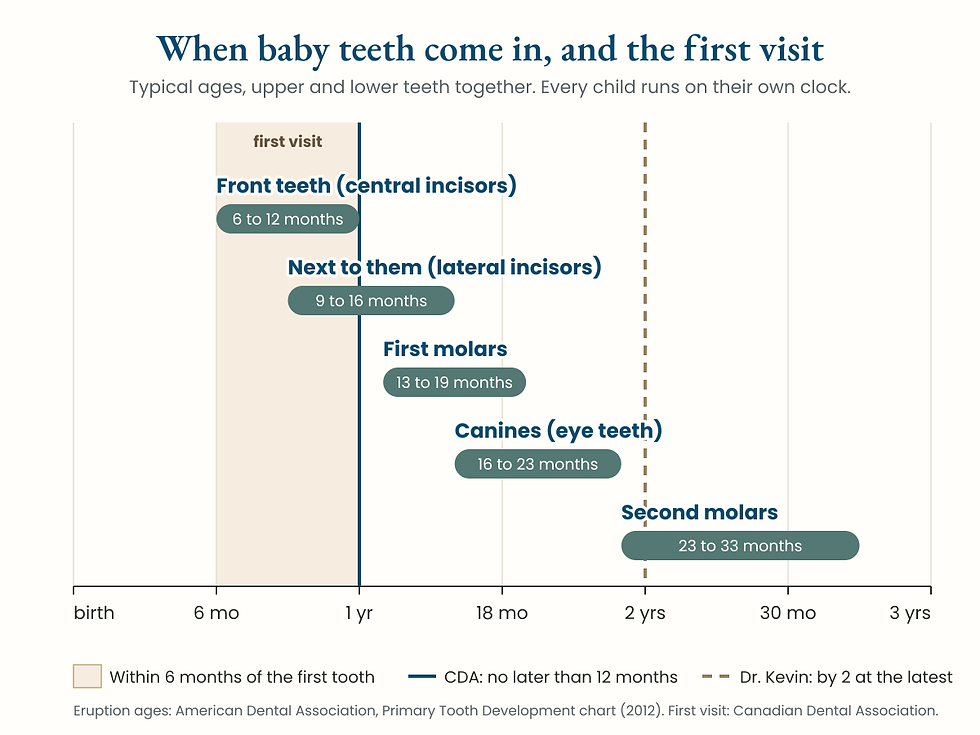
The first visit sits early on this timeline, while the front teeth are arriving. The same ages are in the table below.
Teeth | When they usually come in |
Central incisors (the front teeth) | Lower 6 to 10 months, upper 8 to 12 months |
Lateral incisors (next to the front teeth) | Upper 9 to 13 months, lower 10 to 16 months |
First molars | Upper 13 to 19 months, lower 14 to 18 months |
Canines (eye teeth) | Upper 16 to 22 months, lower 17 to 23 months |
Second molars | Lower 23 to 31 months, upper 25 to 33 months |
Every child runs on their own clock, so a tooth that turns up a few months early or late is usually nothing to worry about. Notice that the first molars tend to come in before the canines, so a space beside the front teeth for a few months is normal. If you're not sure whether your child's teeth are on track, that is a perfect question to bring to the first visit.
Why see the dentist so early, when there are only a few teeth?
Because the habits that lead to cavities in little teeth start long before you can see a cavity. The Canadian Dental Association's position is that the risk factors, things like feeding patterns, how the enamel has formed, brushing at home and access to fluoride, can be picked up by the age of one. It also describes early childhood cavities as a significant problem, serious enough that some children need treatment in hospital for them.
So the honest truth is that the point of a first visit is usually not to fix anything. It's to catch a bedtime bottle habit before it turns into a cavity, to decide together whether your child needs fluoride yet, and to let your child meet us on a good day rather than a sore one. A first visit at 12 months is a chat. A first visit at four, with a toothache, is a very different afternoon.
We just want them to feel nice and relaxed and welcome, to set them up for the rest of their lives.
What happens at a child's first dental visit?
Not much that is scary. For a baby or a toddler the whole thing is short, and it usually goes in four steps.
Hello, and the chair. Your child gets to see the room, sit in the chair with you and have fun with us. We have lots of toys, and lots of good programs on the TV for them.
A look and a count. For a baby, the exam is often done with your little one lying back on your lap, so they can see your face the whole time. We count the teeth, check the gums, tongue and bite, and look along the gumline for the earliest signs of decay.
Fluoride varnish, if your child needs it. Fluoride varnish is a thin coating painted onto the teeth to help protect the enamel. It is painted on, not drilled and not injected. The Canadian Dental Association advises talking professional fluoride through with your dentist, and ties how often it is used to your child's risk of cavities, which is part of what we are checking in step two.
Tips for you. Then it's your turn. We go through brushing, how much toothpaste, bottles and sippy cups, night feeds, and when to come back.

The four steps, written out in full above.
How long does it take? At Meraki, the Chair Ride for toddlers under two is booked as a 30-minute visit. For children from two up to nine, our New Patient Exam for children under 9 is an exam, a polish and fluoride, booked for 45 minutes. From nine, the new patient exam adds two bitewing x-rays (small pictures of the back teeth) and is booked for an hour.
And don't worry, we never force anything when it's their first time. If your little one would rather sit on your lap and watch today, that's absolutely fine. It's usually just a very fun, relaxing experience.
Is your little one ready for a first visit?
A 30-minute first visit for toddlers under two. Tuesday to Saturday, 9am to 5pm.
How do I prepare my child for their first dental visit?
Keep it light, short and ordinary. Children take their cue from you, so the way you talk about the dentist at home matters more than anything we do in the room. A few things that help:
Play dentist at home. Take turns counting each other's teeth with a toothbrush. Then the real count feels familiar.
Read a picture book about a visit to the dentist in the week before.
Use plain, friendly words. "The dentist is going to count your teeth" works better than "it won't hurt", which puts the word hurt in their head.
Pick a good time of day. Book when your child is usually rested and fed, not over nap time. We open at 9am, Tuesday to Saturday, so a Saturday morning is an option.
Bring a comfort toy or a favourite blanket.
Mind your own nerves. If the dentist makes you anxious, try to keep it to yourself on the day. Little ones notice.
Let them watch. If an older brother or sister has a check-up, bring the little one along to see how ordinary it is.
And if today isn't the day, it isn't. We would much rather try again next time than turn the dentist into something to dread. Some days you may also meet Jasper, the small dog who comes to work with Dr. Vivian.
Is the first dental visit free in BC?
Not automatically. MSP, BC's medical plan, does not pay for a check-up in a dental office. According to the Government of BC, dental procedures are covered by MSP only when they are listed in its dental payment schedule and performed in a hospital. So a child's first visit is paid like any other dental visit: through a workplace dental plan if you have one, or through one of the two public programs below if your family qualifies.
Ask our front desk about the cost when you book, and they will tell you what to expect.
Does BC Healthy Kids cover dental?
Yes, for children in lower-income families. The BC Healthy Kids Program covers basic dental treatment for children under 19 whose families are eligible for MSP supplementary benefits, as long as the family is not receiving income assistance, disability assistance or hardship assistance. Children on assistance get the same dental coverage through their own assistance file.
A few things worth knowing:
It has a limit. Basic dental is covered up to a set amount every two calendar years, and emergency treatment to relieve pain is available once that limit is reached. The government page has the current figure.
It can be combined with the CDCP. The Government of BC says the two can work together.
Not every dental office bills it. The Government of BC advises confirming with the office before treatment. Give us a call and we'll tell you how it works here. For questions about the program itself, the government's Dental Information Line is 1-866-866-0800.
Does the CDCP cover children?
Yes. Children under 18 have been able to apply for the Canadian Dental Care Plan since June 2024. You apply for them as dependants on your own application, and the family has to meet all four of the plan's requirements: no access to private dental insurance (including through a parent's work), tax returns filed in Canada, an adjusted family net income under the federal limit, and Canadian residency for tax purposes. The current income limit is on the canada.ca eligibility page.
For a young child, the parts that matter most are covered. The CDCP coverage list includes dental exams, x-rays, cleaning, fluoride and sealants, plus fillings when they are needed.
We bill the CDCP directly. You don't pay the whole bill and wait to be reimbursed. On the day you pay your co-payment, plus anything charged above the CDCP fee, and we tell you what that is before we start. One timing tip: coverage begins on the date in your Sun Life welcome package, and care before that date isn't covered, so apply before you book if you can. Our CDCP guide walks through the rest.
Not sure what your child is covered for?
We can go through your child's coverage with you before you book.
What if my child is older than two and has never been?
Come in now. It isn't too late, and nobody here is going to give you a lecture. The first visit is still gentle, and we still never force anything. For a child between two and nine, book the New Patient Exam for children under 9 instead of the Chair Ride.
When should I call the dentist sooner?
Usually, you can wait for the first visit. Most little-mouth worries are normal parts of growing teeth. One thing you can do tonight: gently lift your child's top lip and look at the front teeth along the gumline. These are the things that should not wait:
What you notice | What to do |
Drooling, chewing everything, a bit grumpy. Usually teething | Normal. A clean, cool teething ring helps. Mention it at the first visit |
A tooth arriving a few months early or late. Normal variation | Can wait. Ask us at the first visit |
Chalky white lines or spots along the gumline of the top front teeth. Can be the first sign of decay | Book a visit in the next few weeks |
Brown or dark spots on a tooth. Can be decay | Book a visit soon |
A fall that chips, loosens or pushes in a baby tooth | Call us that day. For any head injury, go to the emergency department first |
Swelling in the gum or face, or a sore tooth with a fever. Can be an infection | Call us the same day. If we are closed, see a doctor |
Looking for a kids' dentist in South Surrey?

Reception at Meraki Dental, South Surrey.
Meraki Dental is a big family that will welcome all your kids. A few practical things parents ask at the front desk:
We are open Tuesday to Saturday, 9am to 5pm. Saturday mornings are easier to fit around school and work.
First visits at your child's pace. Toys, programs on the TV, a ride in the chair, and nothing forced.
We speak your language. Dr. Vivian and I speak Mandarin, Dr. Rupi speaks Punjabi, and Jessica, our hygienist, speaks Mandarin and Cantonese.
We bill the CDCP directly, and we go through your child's coverage with you before anything is done.
Easy to get to. 2940 King George Blvd, Unit 100, with free parking on site and on the street, and wheelchair access.
Frequently asked questions
What age should a child first see a dentist in Canada?
Within six months of their first tooth coming in. The Canadian Dental Association says no later than 12 months of age, or within six months of getting the first tooth. Most babies get their first tooth between six and ten months, so the first visit usually falls around the first birthday. Dr. Kevin Zhang's rule of thumb at Meraki Dental is that every child should have seen a dentist at least once by age two.
What happens at a baby's first dental visit?
It is short and gentle. For a baby, the exam is often done with your child lying back on your lap, so they can see your face. The dentist counts the teeth, checks the gums, tongue and bite, and looks for early signs of decay. Fluoride varnish may be painted on if your child needs it. Most of the visit is advice for you: brushing, toothpaste, bottles and when to come back.
Is a child's first dental visit free in BC?
Not automatically. MSP does not pay for a check-up in a dental office; it covers dental procedures only in specific cases performed in hospital. A child's first visit is paid like any dental visit: through a workplace dental plan, or through the BC Healthy Kids Program or the Canadian Dental Care Plan if your family qualifies. Ask the clinic for the cost before you book.
Does the Canadian Dental Care Plan cover children?
Yes. Children under 18 have been able to apply since June 2024. A parent applies for them as dependants, and the family must have no access to private dental insurance, have filed taxes in Canada, be under the federal income limit and be Canadian residents for tax purposes. The CDCP covers children's exams, x-rays, cleanings, fluoride, sealants and fillings. Meraki Dental bills the CDCP directly.
Who qualifies for BC Healthy Kids dental coverage?
Children under 19 in families that are eligible for MSP supplementary benefits and are not receiving income assistance, disability assistance or hardship assistance. Healthy Kids pays for basic dental treatment up to a set limit every two calendar years, plus emergency treatment for pain once that limit is reached. It can be combined with the CDCP. Not every dental office bills Healthy Kids, so ask before the visit.
Should I use fluoride toothpaste on my baby's teeth?
It depends on your child's risk of cavities, which is one good reason for an early first visit. The Canadian Dental Association recommends daily fluoride products before age three if a child is at risk of cavities, and your dentist can tell you whether yours is. If fluoride toothpaste is recommended, use only a tiny smear, about the size of a grain of rice, and do the brushing for them.
Do I need a pediatric dentist or a family dentist for my child?
Most children are well looked after by a general family dentist for check-ups, cleanings and small fillings. A pediatric dentist is a specialist with extra training in children's dentistry, and is usually the right choice for children with complex medical needs or extensive treatment, especially under general anaesthetic. A family dentist will refer your child to a specialist when that is what they need.
Book your child's first visit in South Surrey
So: within six months of that first tooth, and by two at the latest. Bring them in, let them ride the chair, count a few teeth with us, and go home with a good first memory of the dentist. Everyone here at Meraki Dental will be happy to have you join our family. See you soon!
Or call 604-385-1823. Meraki Dental, 2940 King George Blvd, Unit 100, Surrey, BC. Tuesday to Saturday, 9am to 5pm. Rated 4.9 from 142 Google reviews at the time of writing.
Sources: Canadian Dental Association, Position on First Visit to the Dentist (approved 2005, reaffirmed March 2012) and Position on Fluoride (approved February 2021); American Dental Association, Primary Tooth Development eruption chart (2012); Government of British Columbia, BCEA Policy and Procedure Manual, Healthy Kids and Dental and Orthodontic Services (eligibility effective 26 June 2024); Government of British Columbia, MSP information for dentists; Government of Canada, Canadian Dental Care Plan: Do you qualify, Apply, and What services are covered (read 2 October 2026); Health Canada news release, children under 18 eligible to apply to the Canadian Dental Care Plan (27 June 2024). Service lengths from Meraki Dental's online booking, 2 October 2026. Review count from Google, 2 October 2026.


Comments