
Do I Need My Wisdom Teeth Out? When They Should Come Out, and When They Can Stay

Updated: 5 days ago
No, not always: wisdom teeth, the four third molars at the very back of your mouth, only need to come out when they cause a problem or cannot be kept clean. They usually come in between the ages of 17 and 25, and one that has come in straight, does its job and stays healthy can usually stay where it is and be checked at your regular visits.
Hmm, my dentist mentioned my wisdom teeth at my last check-up. Do I really need them out? All four of them? And if I do, when should I do it, and how bad is the recovery going to be? So let's talk a little bit about it. My name is Dr. Kevin Zhang. This is Meraki Dental in South Surrey, and we do a lot of wisdom teeth here.
The short version
• Most people today don't have room for wisdom teeth, so they come in sideways or partway and are hard to keep clean. That is when they need to come out.
• An upright, healthy wisdom tooth you can brush can usually stay. So can one buried in bone that causes no trouble, checked on X-rays.
• Recovery takes a couple of days. Soft food, no straws or smoking on day one, and call if pain gets worse after day 3.
• The CDCP covers extractions, and we offer oral sedation for wisdom teeth.
Written from Dr. Kevin Zhang's own explanation. Dr. Kevin is a general dentist and co-owner at Meraki Dental in South Surrey. Reviewed against the sources listed below on 2 October 2026.
Why do so many people need their wisdom teeth out?
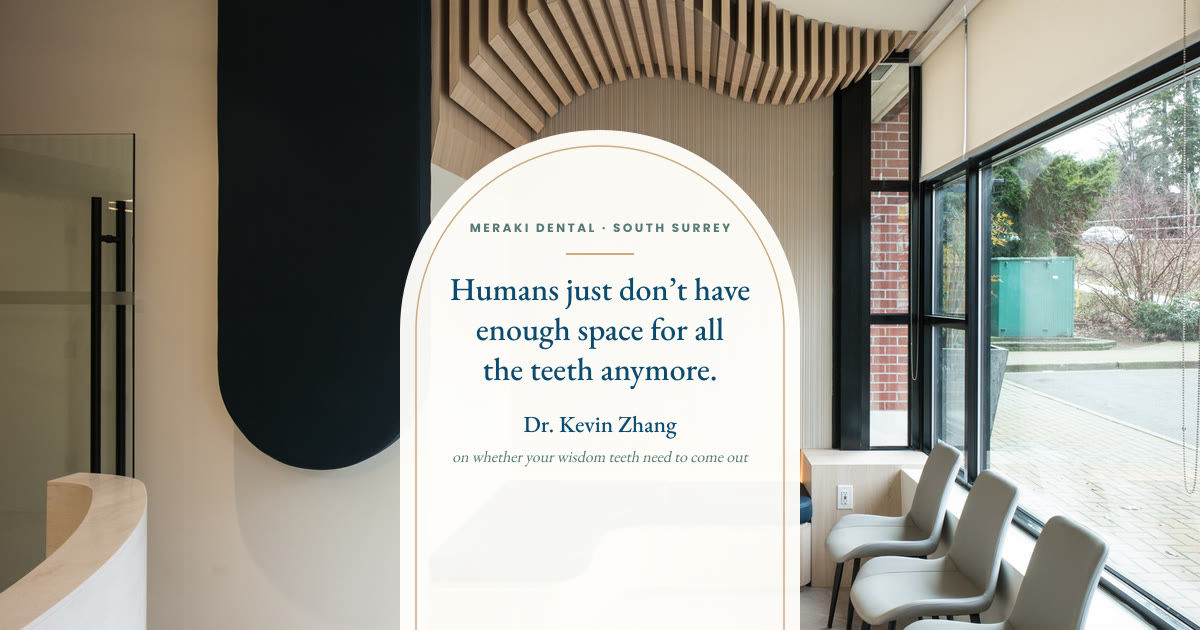
Space. Now we're in the 21st century, humans just don't have enough space for all the teeth anymore. Back in the day, when we had a really, really rough diet and we were literally chewing roots and tree bark, teeth got worn down a lot faster, so we could fit a lot more teeth in. By the time the wisdom teeth came in, there was enough space for them.
Not so much the case with a modern, refined diet. Cakes and hamburgers unfortunately just don't wear teeth down the same way, which is not necessarily a bad thing, except when it comes to the wisdom teeth.
When there isn't room, wisdom teeth don't come in straight. They come in sideways, or slanted, or only part of the way. And that's a problem. Not so much because they push on the front teeth: a 2020 Cochrane review found no evidence that removing symptom-free wisdom teeth makes a real difference to crowding. The problem is that when they're sideways or slanted, you just can't really keep them clean. That's why wisdom teeth in most people these days have to be removed.
Can wisdom teeth be left in?
Yes, and this is the part people are not always told. Notice I said most people, not everyone. A wisdom tooth that has come in fully, sits upright, meets the tooth above it, and that you can reach with a toothbrush and floss, is just another molar. There is no reason to take out a healthy tooth because of its name.
The guidance agrees. The American Association of Oral and Maxillofacial Surgeons says wisdom teeth may not need to be extracted if they grow in completely and are functional, cause no pain, and are free of cavities and disease, with healthy gum around them. They still need cleanings, regular check-ups and an X-ray now and then. In the UK, the NICE guidance on the extraction of wisdom teeth (2000) goes further: impacted wisdom teeth that show no disease should not be taken out just in case, and surgery should be kept for teeth with a real problem, like decay that cannot be fixed, infection, a cyst, or damage to the tooth next door.
Not every expert lands in exactly the same place. The 2020 Cochrane review looked for the best studies on buried, symptom-free wisdom teeth and concluded there is not enough evidence to say whether they should be removed or left. What that means in practice: a healthy wisdom tooth is a tooth to watch, not a tooth to rush out, and the X-ray, not the calendar, should make the call.
Which wisdom teeth usually need to come out?
The ones stuck partway or tipped over. Where a wisdom tooth sits decides most of this, and there are four common positions.

Upright and buried teeth can often stay. Partly erupted and angled ones are the usual trouble. The same information is in the table below.
Where the tooth sits | What usually happens |
Fully erupted: upright, level with the other molars, easy to brush | Usually can stay. Check it at your regular visits |
Partly erupted: part of the tooth is through, with a flap of gum over the back of it | Often comes out. Food gets trapped under the flap and the gum gets infected (pericoronitis). A second flare-up is the usual signal |
Angled forward: tipped into the molar in front, often partly through the gum | Often comes out. Food packs into the gap, and the molar in front can decay or get gum disease |
Fully impacted: buried in bone under the gum, with no pain and no infection | Often left and watched, with an X-ray now and then. It comes out if a problem shows up |
The "second flare-up" rule comes from NICE: a first episode of pericoronitis, unless it is severe, is not on its own a reason for surgery, but a second or later episode is.
These are tendencies, not rules. Two people whose teeth look the same on paper can need different answers, depending on how well they can clean back there, whether the tooth above has come in, and what the X-ray shows around the roots. Not sure which picture is yours? That is exactly what an exam is for.
When is the best time to have wisdom teeth removed?
Summer, if you're a student. Wisdom teeth are everyone's favourite topic in the summer, and why is that? Because kids are out of school. Summer is the best time to take care of your wisdom teeth, because you can give yourself a couple of days for recovery without missing classes or exams.
For everyone else, the best time is a time you can rest. Avoid booking it right before a wedding, a trip or a big week at work. And if you've been recommended to remove your wisdom teeth in the past, and you've seen enough not to wait, then come in and let's have a chat. A tooth that is already trapping food or flaring up is not likely to find more room on its own.
Does it hurt to have wisdom teeth removed?
Not during the removal itself. It starts with local anaesthetic (freezing), which numbs the area so you do not feel pain, just pressure and movement. Afterwards you will be sore for a few days, which is what the recovery section below is about.
If you're nervous, or the teeth are trickier, we offer oral sedation for wisdom teeth cases here. It is conscious sedation: a medication that makes you calm and drowsy, so you are relaxed rather than tense through the appointment. Dr. Vivian and I both provide it, and you can read more about sedation at Meraki Dental. If you choose sedation, you will need someone to drive you home, and you should not drive for the rest of the day.
Is a painful wisdom tooth an emergency?
Usually not, but it can become one. Often, wisdom tooth pain is the gum around a tooth that is coming through, getting sore and swollen because food and bacteria are trapped under it. Until you can be seen, this usually helps:
Rinse with warm salt water a few times a day, especially after eating, to flush out what is trapped under the gum.
Brush back there gently, even though it is sore. The food and plaque are what keep it inflamed.
Take a pain reliever you can normally take, such as acetaminophen or ibuprofen, following the label.
Book an exam, even if it settles. A flare-up that calms down can come back, and a second one is the usual signal that the tooth should come out.
What you notice | What to do |
Sore gum around a wisdom tooth that is coming through | Salt water rinses and gentle brushing. Book an exam in the next week or two |
Pain that keeps coming back, or food always stuck back there | Book an exam. The tooth is telling you something |
Throbbing pain, a bad taste, or swelling in the gum | Call us. We will see you as soon as we can |
Swelling in your face or jaw, or you cannot open your mouth fully | Call us today |
Swelling spreading to your neck or under your tongue, trouble swallowing or breathing, or a fever | Go to an emergency department or call 9-1-1. Do not wait for us |
On the days we are open, our emergency dental care has same-day appointments available for severe pain. If it starts on a Sunday or a Monday, when we are closed, the plan for those two days is further down this page.
Got a wisdom tooth bothering you right now?
Tuesday to Saturday, 9am to 5pm. Same-day appointments are available for severe pain.
What should I expect after wisdom teeth removal?
A couple of sore days, then steady improvement. Give yourself a couple of days for recovery. That's it. For up to 2 weeks you may have some pain, swelling, bruising or a stiff jaw, but according to the NHS, pain and swelling should start to improve after 1 or 2 days. Most people can go back to normal activities the next day, and the American Association of Oral and Maxillofacial Surgeons says most are back to normal life within a week, though full healing of the socket can take up to six weeks.

Everything on this timeline is also written out below.
The first 24 hours
Bite on the gauze and take it easy for the rest of the day.
If it keeps bleeding, fold a clean piece of gauze, put it over the socket and press firmly for at least 10 minutes. A little pink in your saliva is normal.
No straws, no smoking, and no hard spitting or swishing. All three can pull out the blood clot that protects the socket, and that clot is how the socket heals.
No alcohol and no very hot drinks, which can start the bleeding again.
Eat soft, cool food, and chew on the other side.
Take pain relief as directed, such as acetaminophen or ibuprofen.
Days 2 to 3
Soreness and swelling should start to ease.
Start gentle warm salt water rinses after meals, to keep food out of the socket. Let the water fall out of your mouth rather than spitting it hard.
Brush your other teeth normally, and go carefully near the socket.
Keep to soft food, adding a little more texture as it feels comfortable.
Week 1
Most people are back to normal life.
Skip strenuous exercise for the first week, so you do not dislodge the clot.
Keep chewing on the other side and rinsing after meals.
What is dry socket, and how do I know if I have it?
A socket that has lost its blood clot. Dry socket happens when the clot in the socket does not form properly, or comes out too early, leaving the bone underneath uncovered. It is a common complication after a tooth comes out, and it is treatable.
According to the oral and maxillofacial team at East Sussex Healthcare NHS Trust, it usually shows up 3 to 5 days after the extraction. The signs:
an ache or throbbing pain that can feel like a toothache
bad breath, or a bad taste in your mouth
a socket that looks empty, where you may see bone instead of a dark clot
The pattern is the giveaway: it was getting better, and then it gets worse.
The same team lists who is more likely to get it: smokers, people who have had it before, people over 25, harder extractions, lower wisdom teeth in particular, and women taking the oral contraceptive pill. Not following the aftercare instructions raises the risk too, which is why the first 24 hours matter so much.
If you think you have it, call us. The usual treatment is to gently rinse the socket clean and sometimes place a soothing dressing in it, repeated if needed until the pain settles. Dry socket is slow healing, not an infection, so antibiotics are not usually the answer.
What can I eat after wisdom teeth removal?
Soft, cool food that needs almost no chewing, for the first few days. Good choices:
yogurt, applesauce and smoothies (with a spoon, not a straw)
broth or blended soup, once it has cooled
ice cream
mashed potatoes, scrambled eggs, oatmeal and very soft pasta
finely cut fish or meat, as you get more comfortable
Leave these for later: nuts, seeds and popcorn that can get stuck in the socket, anything hard or crunchy, chewy candies, spicy food, acidic fruit like oranges and tomatoes, fizzy drinks, very hot drinks and alcohol.
When should I call the dentist after wisdom teeth removal?
Any time recovery goes the wrong way instead of the right one. Call us if:
bleeding does not stop after pressing on gauze for 10 minutes
pain gets worse after day 3 instead of better, or painkillers stop helping
you notice a bad taste or smell, or pus around the socket
swelling is still growing after day 3
you have a fever or feel unwell
your lip, chin or tongue is still numb the next day, after the freezing should have worn off
Go to an emergency department or call 9-1-1 if swelling spreads to your neck or under your tongue, or you have trouble swallowing or breathing.
If it happens on a Sunday or a Monday
We are open Tuesday to Saturday, 9am to 5pm, so here is the honest plan for the two days we are closed:
Call us when we open, Tuesday at 9am, on 604-385-1823. If things are getting worse before then, do not wait for us: use the options below.
For advice in the meantime, call 8-1-1. HealthLink BC nurses are available 24 hours a day, 7 days a week.
If swelling is spreading, you have a fever, or it is hard to swallow or breathe, go to an emergency department, such as Peace Arch Hospital in White Rock, or call 9-1-1.
If you have your wisdom teeth out on a Saturday, you get the weekend to rest. Read this list before you go home, and keep our number and 8-1-1 handy.
Is wisdom teeth removal covered by insurance or the CDCP?
Usually, at least in part.
CDCP: The Canadian Dental Care Plan lists removal of teeth and roots under oral surgery, so extractions are covered. We bill the CDCP directly, and on the day you pay your co-payment, plus anything above the CDCP fee. Oral sedation is covered only in specific cases, and we submit the preauthorization when one is needed. Our guide to what the CDCP covers walks through the rest.
MSP: Mostly no. BC's Medical Services Plan says the removal of healthy wisdom teeth, even if impacted, is not a benefit. It only covers wisdom tooth surgery that has to be done in hospital because the extraction is extremely complex and there is a problem with the tooth.
Private dental insurance: Extractions are usually part of a dental plan, but the percentage and any yearly maximum depend on yours. We will help you find out what your plan covers before anything is booked.
The fee itself depends on how many teeth come out, how they sit, and whether you choose sedation, so you get the estimate after the exam, once we have seen the X-ray.
Want to know where your wisdom teeth stand?
This books a Specific Examination: 60 minutes focused on one concern, with any X-rays needed. Pick a time and our front desk confirms it.
Wisdom teeth at Meraki Dental in South Surrey

The X-ray room at Meraki Dental, South Surrey.
A few practical things, since people ask them at the front desk:
We do a lot of wisdom teeth here. Dr. Vivian Huang and I both remove wisdom teeth. Dr. Vivian is in Tuesday and Thursday, and I am in Wednesday and Saturday.
Oral sedation, if you would like it, from either of us.
Open Tuesday to Saturday, 9am to 5pm. A Saturday appointment gives you the weekend to rest. Just keep the Sunday and Monday plan above handy.
The CDCP billed directly. On the day you pay your co-payment, plus anything above the CDCP fee, not the whole bill.
We speak your language. Dr. Vivian and I speak Mandarin, Dr. Rupi Dhami speaks Punjabi, and Jessica, our hygienist, speaks Mandarin and Cantonese.
Kind, caring, and a little bit fun. Jasper, Dr. Vivian's small dog, comes to work with her. Say hi.
2940 King George Blvd, Unit 100, Surrey. Free parking on site and on the street.
Frequently asked questions
Do all wisdom teeth need to be removed?
No. Wisdom teeth need to come out when they cause problems, such as infection, decay, damage to the molar in front, or a cyst, or when they sit where you cannot keep them clean. A wisdom tooth that has come in fully, works, and is healthy and easy to brush can usually stay. NICE guidance from 2000 advises against removing impacted wisdom teeth that show no disease.
How do I know if my wisdom teeth need to come out?
An exam with an X-ray tells you. The dentist looks at how each wisdom tooth sits, whether it has room, whether the gum around it keeps getting infected, and whether the molar in front is decaying. Signs worth booking for are pain at the back of your mouth, swollen gum behind your last molar, food always trapped there, or a bad taste that keeps coming back.
Is there such a thing as emergency wisdom teeth removal?
Sometimes, but the emergency is usually the infection. A badly infected wisdom tooth often needs the pain and swelling brought under control first, and the tooth is taken out once things settle. At Meraki Dental in South Surrey, same-day appointments are available for severe pain, Tuesday to Saturday. Swelling that affects your breathing or swallowing needs an emergency department straight away.
How long does it take to recover from wisdom teeth removal?
Most people are back to normal activities within a day or two and back to normal life within a week. Some pain, swelling and jaw stiffness can last up to 2 weeks, but it should start easing after the first 1 or 2 days. Full healing of the socket can take up to six weeks, so avoid strenuous exercise for the first week.
What are the signs of dry socket?
Dry socket usually appears 3 to 5 days after an extraction. The signs are a throbbing ache that can feel like a toothache, bad breath or a bad taste, and a socket that looks empty, sometimes with bone showing. The key clue is pain that was improving and then gets worse. It is treatable, so call your dentist rather than waiting it out.
What can I eat after wisdom teeth removal?
For the first few days, eat soft, cool foods that need little chewing: yogurt, applesauce, smoothies eaten with a spoon, cooled soup, mashed potatoes, scrambled eggs and oatmeal. Avoid straws for at least 24 hours. Skip nuts, seeds, popcorn, crunchy or spicy food, acidic fruit, fizzy drinks, very hot drinks and alcohol until the socket has healed.
Does MSP or the CDCP cover wisdom teeth removal in BC?
The CDCP covers extractions, including wisdom teeth, with a co-payment that depends on your adjusted family net income. BC's MSP does not cover removing healthy wisdom teeth, even impacted ones. It only covers wisdom tooth surgery that must be done in hospital because of extreme complexity and an associated problem. Private dental plans usually cover extractions at your plan's percentage.
Book a wisdom teeth check in South Surrey
If you've been thinking about your wisdom teeth, or you were told in the past that they should come out, come in and let's have a chat. We will look at the X-ray with you, tell you honestly whether they need to come out or can stay, and if they do, plan it around your summer, your exams or your work. Our patients give us 4.9 stars from 142 Google reviews at the time of writing, and kind staff is what they mention most. And we promise you, once they're out, wisdom teeth don't grow back. That's it!
Or call 604-385-1823. Meraki Dental, 2940 King George Blvd, Unit 100, Surrey, BC. Tuesday to Saturday, 9am to 5pm.
Sources: NICE, Guidance on the extraction of wisdom teeth, Technology Appraisal TA1 (2000). Ghaeminia H et al., Surgical removal versus retention for the management of asymptomatic disease-free impacted wisdom teeth, Cochrane Database of Systematic Reviews (2020). American Association of Oral and Maxillofacial Surgeons, Wisdom Teeth Management, Wisdom Teeth FAQ and What to Eat After Wisdom Teeth Removal (read 2 October 2026). NHS, Wisdom tooth removal (reviewed 12 June 2024). East Sussex Healthcare NHS Trust, Oral and Maxillofacial Department, Dry Socket (Alveolar Osteitis) (June 2023). Government of Canada, CDCP: What services are covered (read 2 October 2026). Province of British Columbia, MSP Medical Benefits (updated 25 June 2020). HealthLink BC, 8-1-1 services. Appointment length from Meraki Dental's online booking and review count from Google, both 2 October 2026; review topics from Google, 9 September 2026.


Comments